Leasing is the part of Gurugram real estate where the money is made and lost in the document, not in the location. Two identical units in the same building can produce very different returns depending on lock-in, escalation, who pays CAM, and how the security deposit is structured.
This is written for both sides - the owner leasing out a unit, and the business taking one. The mechanics are the same; the leverage is different.
What Gurugram leasing looks like in 2026
The office market is in a landlord-favourable phase, and the numbers behind that are worth knowing before you negotiate.
Vacancy in the major Gurugram markets has come down to roughly the 14 to 15 percent range, and well-maintained Cyber City buildings have historically run below 10 percent. Cyber City landlords have been moving quoting rents from around Rs 140 to Rs 155 per sq ft per month, and brokers have expected a further 7 to 10 percent rise in prime-corridor rents. NCR recorded around 4.0 million sq ft of leasing in Q1 2026.
The structural driver is Global Capability Centres. Gurugram has been capturing close to 40 percent of all new GCC setups in India - multinationals building large captive back-office and engineering operations. These are big, long-lease, high-credit tenants, and they are the reason the prime end of this market is tight.
What rent to expect
Ranges rather than single numbers, because grade and fit-out level move these a lot:
| Segment | Indicative rent (per sq ft / month) |
|---|---|
| Cyber City Grade A | Rs 140 - 200 |
| Golf Course Road offices | High, close behind Cyber City |
| New Gurugram offices | From around Rs 45 |
| SCO ground-floor retail | Rs 120 - 250 |
| SCO first and second floor offices | Rs 60 - 120 |
On yields: ground-floor SCO retail is commonly quoted at 8 to 12 percent, upper-floor offices at 7 to 10 percent net of operating costs. Residential, for comparison, sits around 3 to 4.5 percent. That gap is the entire case for commercial - and the price of it is vacancy risk and a smaller pool of buyers when you exit.
The lease terms that actually decide your return
If you read nothing else, read this section.
Lock-in period
The period during which the tenant cannot walk away without penalty. For an owner, this is the core of your income security - a nine-year lease with a one-year lock-in is really a one-year lease. For a tenant, a long lock-in is a real liability if your headcount plans change, so trade it against rent.
Typical shapes in Gurugram: three-year leases with a one-year lock-in for small offices and retail; five to nine year leases with a three to five year lock-in for large corporate space.
Escalation clause
How much rent rises and how often. The common Indian structure is 15 percent every three years, or 5 percent annually. Over a nine-year lease the difference between those two compounds into a materially different total. Model it before you sign, on both sides.
Security deposit
Usually expressed in months of rent - typically three to six for offices, sometimes higher for retail. Two things owners get wrong: not specifying the timeline and conditions for refund, and not agreeing what constitutes fair wear and tear on the fit-out. Both become disputes at exit.
CAM - common area maintenance
Charged separately from rent, per square foot per month, covering security, housekeeping, common power, lifts and landscaping. The classic mistake on the tenant side is comparing two buildings on rent alone when their CAM differs significantly. Always compare rent plus CAM.
Establish who pays CAM during a fit-out period and during any vacancy - it is negotiable and frequently left ambiguous.
Fit-out period and rent-free
Tenants normally negotiate a rent-free period - commonly 30 to 90 days - to build out the space. From the owner's side, that is a real cost, so price it into the effective rent rather than treating it as a giveaway.
Chargeable versus carpet area
Gurugram commercial rent is usually quoted on chargeable or super area, which can be substantially larger than usable carpet area. A cheaper-looking rent on a higher loading factor can cost more per usable seat. Ask for both numbers and compare on carpet.
If you are an owner leasing out a unit
Priorities, in order of how much they affect your actual return:
- Tenant covenant over headline rent. A multinational or listed company on a nine-year lease with a five-year lock-in is worth more than a higher rent from a two-year-old business on a three-year lease. It also directly affects your exit value, because pre-leased assets are priced off the strength of the lease.
- Lock-in length. Vacancy is what destroys commercial returns. A quoted 10 percent yield with three months vacant every two years is not a 10 percent yield.
- Escalation. Get it in the document, with defined dates. Verbal understandings about future increases are worth nothing.
- Position within the project, for retail. Ground floor, corner, visible from the main road, near the anchor tenant. Within a retail project the spread between the best and worst unit is enormous, and it does not close over time.
- Registration. Leases beyond a short duration should be registered. An unregistered long lease creates evidentiary problems exactly when you need the document to work.
If you are a business taking space
- Compare on rent plus CAM, on carpet area. Two quotes are not comparable until you have normalised both.
- Negotiate the fit-out rent-free period explicitly, with a defined start date tied to handover of the bare shell, not to signature.
- Match lock-in to your actual growth plan. If you might double headcount in 24 months, a five-year lock-in on a space that fits today is a problem you are buying.
- Check power backup and the actual sanctioned load, not the brochure figure. This bites hardest in older buildings.
- Confirm the exit terms and deposit refund conditions before you sign, not when you are leaving. Your leverage is highest before signature and near zero afterwards.
Which Gurugram sub-market suits which tenant
| Sub-market | Profile | Typical tenant |
|---|---|---|
| Cyber City | Highest rent, lowest vacancy | MNC head offices, GCCs |
| Golf Course Road | Premium, strong address | Financial services, consulting |
| Golf Course Extension / SPR | Mid-premium, newer stock | Growing mid-size companies |
| Dwarka Expressway | Newer supply, Delhi-facing | Firms with Delhi-side staff |
| New Gurugram | Lowest rent | Back-office, support functions |
| SCO / high street | Retail and small office | QSR, cafes, banks, clinics, co-working |
A note on SCO leasing specifically
Shop-cum-office formats have been the most heavily marketed commercial product in Gurugram, and the leasing story is genuinely reasonable: demand comes from QSR chains, cafes, banks, clinics, co-working operators and professional practices, and well-located ground-floor units in completed projects typically lease within three to six months.
The part to discount heavily is the appreciation forecasting. SCO marketing routinely projects 18 to 35 percent annual capital appreciation and total returns of 100 to 250 percent over three to five years. Those are promoter projections with nothing underwriting them. The rental yield case for SCO is defensible. The capital appreciation forecasts are not, and a plan built on them is not a plan.
See SCO plots in Gurgaon and retail shops in Gurgaon. Related: SCO plots on Sohna Road.
Where to start
If you are leasing out a unit, the highest-value thing you can do is get the lease drafted properly rather than using a template - the difference between a well-structured and a sloppy lease is usually larger than the difference between two locations.
If you are taking space, get the rent, CAM, carpet area and escalation normalised across your shortlist before you fall in love with a building.
We handle both sides of this. Browse commercial property in Gurgaon, see our advisory services, or tell us what you need.
The buildings behind the theory
Everything above is lease structure. These are the live commercial assets in Gurugram it applies to, split by how far along they are:

| Project | Location | Status |
|---|---|---|
| Emaar Business District | Sector 114, Dwarka Expressway | Ready to move, December 2024 |
| M3M SCO | Sector 113, Dwarka Expressway | Completed July 2023 |
| AIPL Joy Central | Sector 65, Golf Course Extension | Ready to move, December 2022 |
| M3M Urbana | Sector 67, Golf Course Extension | Ready to move, December 2021 |
| Trehan Iris Broadway | Sector 85, New Gurugram | Ready to move, December 2020 |
| M3M Route 65 | Sector 65, Golf Course Extension | Under construction, February 2027 |
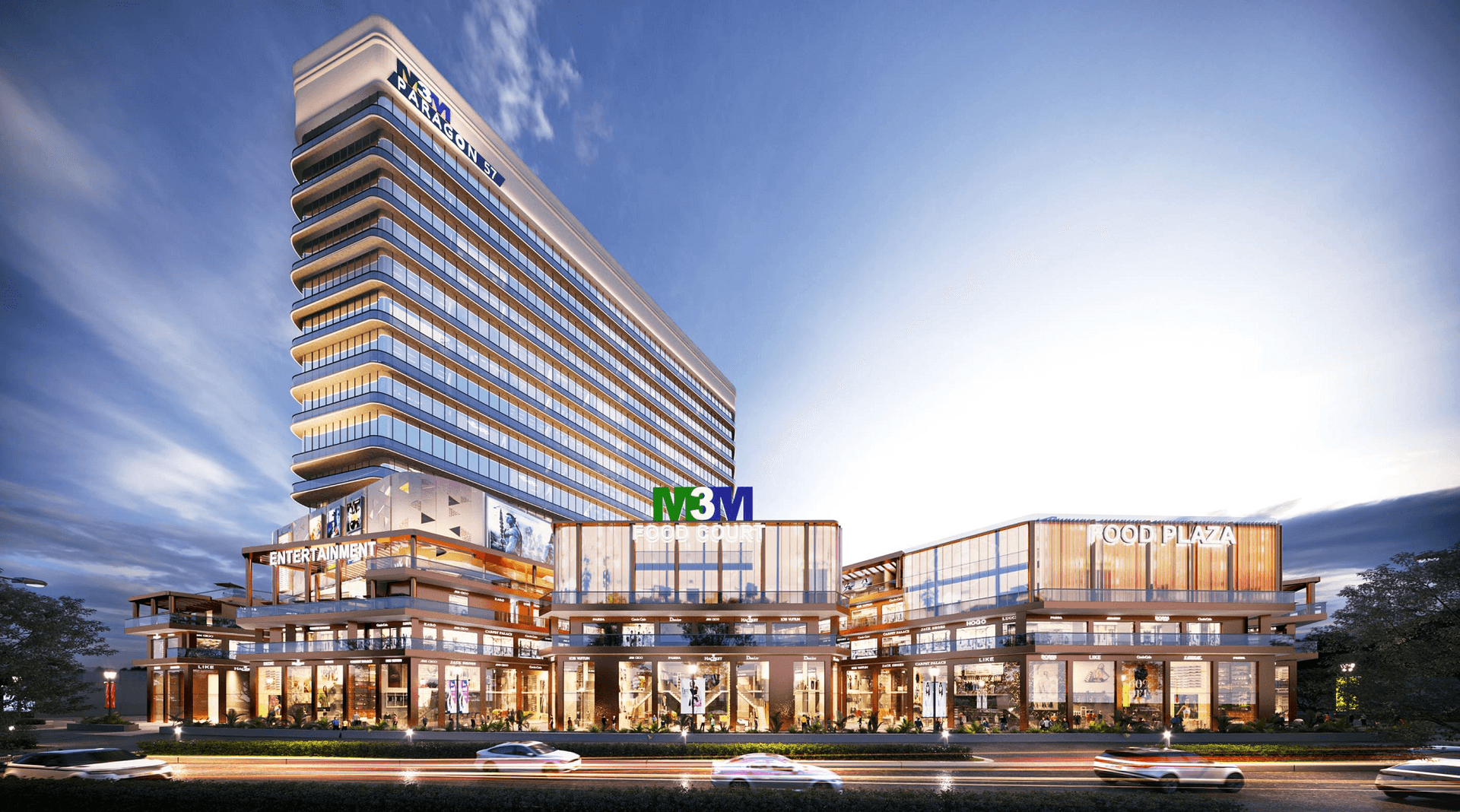
| M3M Paragon | Sector 57, Golf Course Extension | Under construction |
| Reach The Bazaria | Sector 68, Sohna Road | New launch |
The split is worth noting on its own: five of these eight are finished. In commercial that is the difference between a rent you can verify and a rent someone has forecast for you.