Buying a property is a major financial decision, and choosing the right type of property can significantly impact your finances, convenience, and long-term returns.
One of the most important decisions buyers face is whether to purchase a ready-to-move property or invest in an under-construction property.
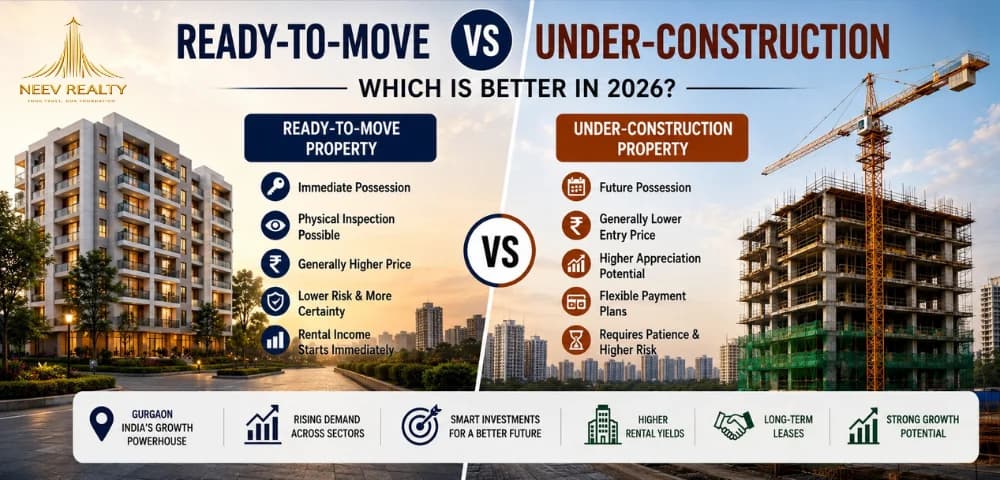
A ready-to-move property offers immediate possession, greater certainty, and the opportunity to inspect the completed unit. An under-construction property, meanwhile, can offer a lower entry price and potential for long-term appreciation.
So, which one is better in 2026?
The answer depends on your budget, investment horizon, risk tolerance, and whether you are buying for personal use or investment.
Ready-to-Move vs Under-Construction Property: Quick Comparison
| Factor | Ready-to-Move Property | Under-Construction Property |
|---|---|---|
| Possession | Immediate or near-immediate | Future possession |
| Construction Risk | Low | Relatively higher |
| Property Inspection | Full physical inspection possible | Limited to construction stage |
| Rental Income | Can begin after possession | Starts after possession |
| Entry Price | Generally higher | May be lower during early stages |
| Payment Flexibility | Usually limited | Construction-linked plans may be available |
| Appreciation | Relatively stable | Potentially higher in developing locations |
| Best Suited For | End-users & conservative buyers | Long-term investors |
What Is a Ready-to-Move Property?
A ready-to-move property is a completed residential unit that is available for possession.
For homebuyers who want immediate occupancy, this option provides a major advantage. Buyers can inspect the actual apartment, evaluate construction quality, understand the layout, and assess the surrounding infrastructure before completing the purchase.
Another advantage is greater financial predictability. Once possession is available, buyers can move into the property or potentially rent it out without waiting for construction to be completed.
The primary trade-off is price. Since the property is completed and immediately usable, ready-to-move homes may command a premium compared with comparable early-stage projects.
Benefits of Ready-to-Move Properties
-
Immediate possession
-
Lower construction and delivery uncertainty
-
Physical inspection before purchase
-
Immediate usability or rental potential
-
Better visibility of surrounding infrastructure
-
Suitable for buyers seeking stability
What Is an Under-Construction Property?
An under-construction property is a residential project that is still being developed and is scheduled for possession at a future date.
These properties can be attractive to buyers because developers may offer relatively competitive pricing during the early stages of a project. Construction-linked payment plans can also allow buyers to spread payments over the development period.
For investors, the biggest attraction can be the potential for capital appreciation as construction progresses and infrastructure develops around the project.
However, buyers must also consider construction timelines, developer credibility, market conditions, and the possibility of delayed possession.
Benefits of Under-Construction Properties
-
Potentially lower entry price
-
Construction-linked payment options
-
Potential for capital appreciation
-
Opportunity to invest in emerging locations
-
Suitable for long-term investors
Ready-to-Move vs Under-Construction: Key Differences
1. Possession Timeline
The biggest difference is the possession timeline.
A ready-to-move property allows the buyer to use the property almost immediately after completing the required transaction and possession formalities.
An under-construction property requires the buyer to wait until construction is completed and possession is offered.
If immediate possession is your priority, a ready-to-move property is generally the more practical choice.
2. Price and Initial Investment
Under-construction properties may provide buyers with an attractive entry point, particularly during the early stages of development.
Ready-to-move properties, on the other hand, can carry a premium because the buyer is purchasing a completed asset with immediate usability.
However, buyers should compare the total acquisition cost, rather than focusing only on the quoted property price.
3. Construction and Delivery Risk
Ready-to-move properties eliminate most construction-related uncertainty because the project has already reached completion.
With an under-construction property, buyers need to assess:
-
Developer track record
-
Project approvals
-
Construction progress
-
Possession timeline
-
Project registration and documentation
-
Contractual terms
A lower purchase price should not be the only reason to select an under-construction project.
4. Rental Income
A ready-to-move property can potentially generate rental income soon after possession.
With an under-construction property, rental income generally begins only after the project is completed and possession is provided.
Therefore, investors focused on immediate cash flow may find ready-to-move properties more suitable.
5. Capital Appreciation
Under-construction properties can offer attractive appreciation potential when they are located in areas experiencing strong infrastructure development, improving connectivity, and increasing residential or commercial demand.
Ready-to-move properties in established locations may offer greater stability because the surrounding infrastructure and market demand are already visible.
Therefore, appreciation potential depends not only on the construction stage but also on location, demand, infrastructure, pricing, and project quality.
6. GST and Other Costs
Tax treatment can differ depending on whether a property is under construction or completed and eligible for the relevant completion documentation.
Buyers should therefore verify the applicable tax treatment and other transaction costs with a qualified tax or real-estate professional before making a purchase decision.
Which Property Is Better for Homebuyers?
For an end-user who wants to move into a home quickly, a ready-to-move property can be the more suitable option.
It offers greater certainty, allows physical inspection, and removes the waiting period associated with construction.
It may particularly suit buyers who:
-
Need immediate possession
-
Want to avoid construction delays
-
Prefer established neighbourhoods
-
Want to inspect the finished property
-
Need immediate rental potential
-
Prefer lower uncertainty
Which Property Is Better for Investors?
An under-construction property can be considered by investors with a longer investment horizon and a higher tolerance for uncertainty.
It may be particularly attractive when the project is located in an emerging growth corridor where infrastructure development and increasing demand could support future appreciation.
Investors should focus on the fundamentals rather than simply choosing the cheapest project.
Important factors include:
-
Developer reputation
-
Location
-
Connectivity
-
Infrastructure pipeline
-
Project specifications
-
Construction progress
-
Demand and rental potential
-
Exit opportunities
Gurugram: Ready-to-Move vs Under-Construction
Gurugram provides a good example of how both property categories can appeal to different buyer profiles.
Established micro-markets such as Golf Course Road offer mature infrastructure, established commercial activity, and strong residential demand.
On the other hand, developing corridors such as Dwarka Expressway and Sohna Road continue to attract buyers and investors looking for future growth opportunities.
This highlights an important point: the location and quality of a project can be more important than simply choosing between ready-to-move and under-construction properties.
Common Mistakes Buyers Should Avoid
Before investing in either type of property, buyers should avoid making decisions based solely on the advertised price.
Avoid these common mistakes:
1. Choosing only on the basis of price
A lower price does not automatically mean a better investment.
2. Ignoring the developer's track record
Past delivery performance and project execution are important indicators.
3. Overlooking location fundamentals
Connectivity, infrastructure, employment hubs, schools, healthcare, and commercial development can influence future demand.
4. Not calculating the total cost
Consider registration, financing, taxes where applicable, maintenance, holding costs, and other associated expenses.
5. Ignoring the exit strategy
Investors should consider how easily the property can be rented or sold in the future.
Ready-to-Move or Under-Construction: What Should You Choose?
There is no one-size-fits-all answer.
Choose a Ready-to-Move Property If:
-
You want immediate possession
-
You prefer lower construction risk
-
You want to inspect the completed property
-
You need immediate rental potential
-
You prefer established infrastructure
-
You value certainty over speculative appreciation
Choose an Under-Construction Property If:
-
You have a long-term investment horizon
-
You are comfortable waiting for possession
-
You are targeting a developing location
-
You want a potentially lower entry price
-
You are willing to undertake detailed due diligence
-
You are targeting future appreciation
Final Verdict
The choice between a ready-to-move and an under-construction property should be based on your financial goals, investment horizon, risk tolerance, and end-use requirements.
A ready-to-move property generally offers greater certainty, immediate possession, and immediate usability.
An under-construction property can offer potentially attractive entry pricing and long-term appreciation opportunities, particularly in high-growth locations.
Ultimately, the smartest property investment is not simply about choosing between "ready" and "under construction." It is about finding the right property, in the right location, from a credible developer, at a price that makes financial sense.