Most guides to renting office space in Gurugram are lists of buildings. That is not the hard part. The hard part is that the rent you are quoted is not the rent you pay, the area you are shown is not the area you get, and the lock-in you sign determines whether a bad decision costs you three months or three years.
This is the tenant-side guide we give clients before they see a single building.
The market you are walking into
Gurugram is the strongest office market in NCR and it is a landlord's market right now. Some context worth having:
- Gurugram recorded the highest commercial absorption in NCR in 2024, at over 6.8 million sq ft on JLL's numbers.
- Global Capability Centres are the dominant demand driver, and Gurugram captures a large share of new GCC set-ups in India — one estimate puts it near 40 percent of new mandates.
- Vacancy in well-managed Cyber City buildings has historically stayed below 10 percent, against a wider NCR figure closer to 14 to 15 percent.
- Brokers expect prime-corridor rents to rise 7 to 10 percent through mid-2026, with quality space getting tighter.
Practical implication: if you need Grade A space in Cyber City, you have limited leverage on rent, and you should spend your negotiation on fit-out period, escalation and exit flexibility instead. Those are often worth more than a few rupees per square foot anyway.
Where to look, by what you actually need
| Micro-market | Indicative rent (per sq ft/month) | Best for |
|---|---|---|
| DLF Cyber City / Cyber Hub | Roughly Rs 120–200, with quoting rates often cited around Rs 140–155 | MNC headquarters, GCCs, client-facing brands |
| Golf Course Road (Sec 42–43) | Premium, close behind Cyber City | Funds, consulting, boutique professional firms |
| Golf Course Extension (Sec 58–67) | Meaningfully below Cyber City | Growing companies wanting Grade A without the Cyber City premium |
| Sohna Road / Sec 48–49 | Mid-market | Back-office, support functions, cost-sensitive teams |
| Udyog Vihar / Old Gurugram | Lowest of the established markets | Operations, studios, light industrial-adjacent uses |
| Dwarka Expressway (Sec 114 etc.) | Emerging, below the mature corridors | Airport and Delhi-facing teams, longer-term plays |
Rent ranges move with building grade, floor, view and how badly the landlord wants your covenant. Treat the table as a map, not a price list. Current inventory sits under commercial property in Gurgaon.
The five commercial terms that decide your real cost
1. Chargeable area versus carpet area
You will be quoted rent on chargeable or super area. The usable space is the carpet area. The gap — the loading factor — commonly runs 25 to 40 percent in Gurugram Grade A. Two buildings at the same headline rent can differ by a fifth in cost per usable seat. Always convert to rent per carpet square foot before comparing anything.
2. CAM charges
Common Area Maintenance is billed on top of rent, and in premium buildings it is a substantial line item rather than a rounding error. Ask for the current CAM rate, what it covers, how it has moved over the last three years, and whether it is capped. An attractive rent with uncapped CAM is not attractive.
3. Lock-in, and the difference between lock-in and term
A typical structure is a three-year lock-in inside a longer term with renewal options — often described as three plus three or five plus five. Inside the lock-in you owe rent whether you occupy or not. Negotiate the lock-in against your actual business confidence, not the landlord's template. If you are a 30-person company that might be 60 or 15 in two years, lock-in flexibility is worth more than rent reduction.
4. Escalation
Standard practice is a 15 percent increase every three years, or roughly 5 percent annually. Over a nine-year term the compounding matters more than your opening rent. Model the whole term.
5. Security deposit and fit-out period
Expect three to six months of rent as an interest-free deposit. Separately, negotiate a rent-free fit-out period — commonly 30 to 90 days — because you are paying for a space you cannot use while you build it out. Landlords in a tight market resist rent cuts but concede fit-out time relatively readily. Ask.
Registration, GST and the paperwork most tenants get wrong
- Register the lease deed. An unregistered long lease is weak evidence if the relationship sours. Stamp duty on lease deeds in Haryana scales with term and rent — budget for it rather than discovering it at signing.
- GST at 18 percent applies to commercial rent where the landlord is registered. If you are GST-registered, you generally take input credit, so this is cash flow rather than cost. Confirm the landlord's registration status before you sign, and check who bears GST on CAM.
- TDS on rent. As a business tenant you must deduct TDS on commercial rent and deposit it. Get this into your finance process from month one, because catching up on it later is expensive.
- Check the occupation certificate. Leasing space in a building without a valid OC creates real risk, including on your own statutory registrations at that address.
- Confirm permitted use and parking allocation in writing. Parking ratios in Gurugram Grade A are a genuine constraint and a common source of post-signing conflict.
Managed offices and coworking: when they are the right answer
For teams under roughly 30 people, or any team whose headcount is genuinely uncertain, a managed or serviced office usually beats a conventional lease. You pay a visible premium per seat and you get out of CAM negotiation, fit-out capital, deposit lock-up and lock-in exposure entirely. The break-even in our experience sits somewhere between 30 and 50 seats — beyond that, a direct lease with a proper fit-out is cheaper over three years.
The trap is the middle: a 40-person team on a five-year conventional lease in a market it does not understand yet. If that is you, take managed space for a year and lease properly once you know your growth curve.
What we would do in your position
- Fix your carpet-area requirement first — around 70 to 90 sq ft of carpet per seat for a conventional layout — then convert to chargeable area using each building's actual loading.
- Shortlist two micro-markets, not five. Where your senior people live decides retention more than the address does.
- Compare on total occupancy cost per seat per month: rent plus CAM plus parking plus amortised fit-out. Not on headline rent.
- Negotiate fit-out period, escalation cap and lock-in before rent. That is where the concessions actually are in a tight market.
- Have the lease deed reviewed by a lawyer who has read Gurugram leases specifically. The templates carry local quirks.
We handle the landlord side of this market every week and know which buildings negotiate. Tell us your seat count, budget per seat and preferred corridor and we will come back with three options and their real occupancy cost. Our commercial leasing guide covers the broader leasing picture including retail.
What is actually available right now
Rents and micro-markets are the theory. These are the live buildings the numbers above apply to, and all of them are complete rather than promised:
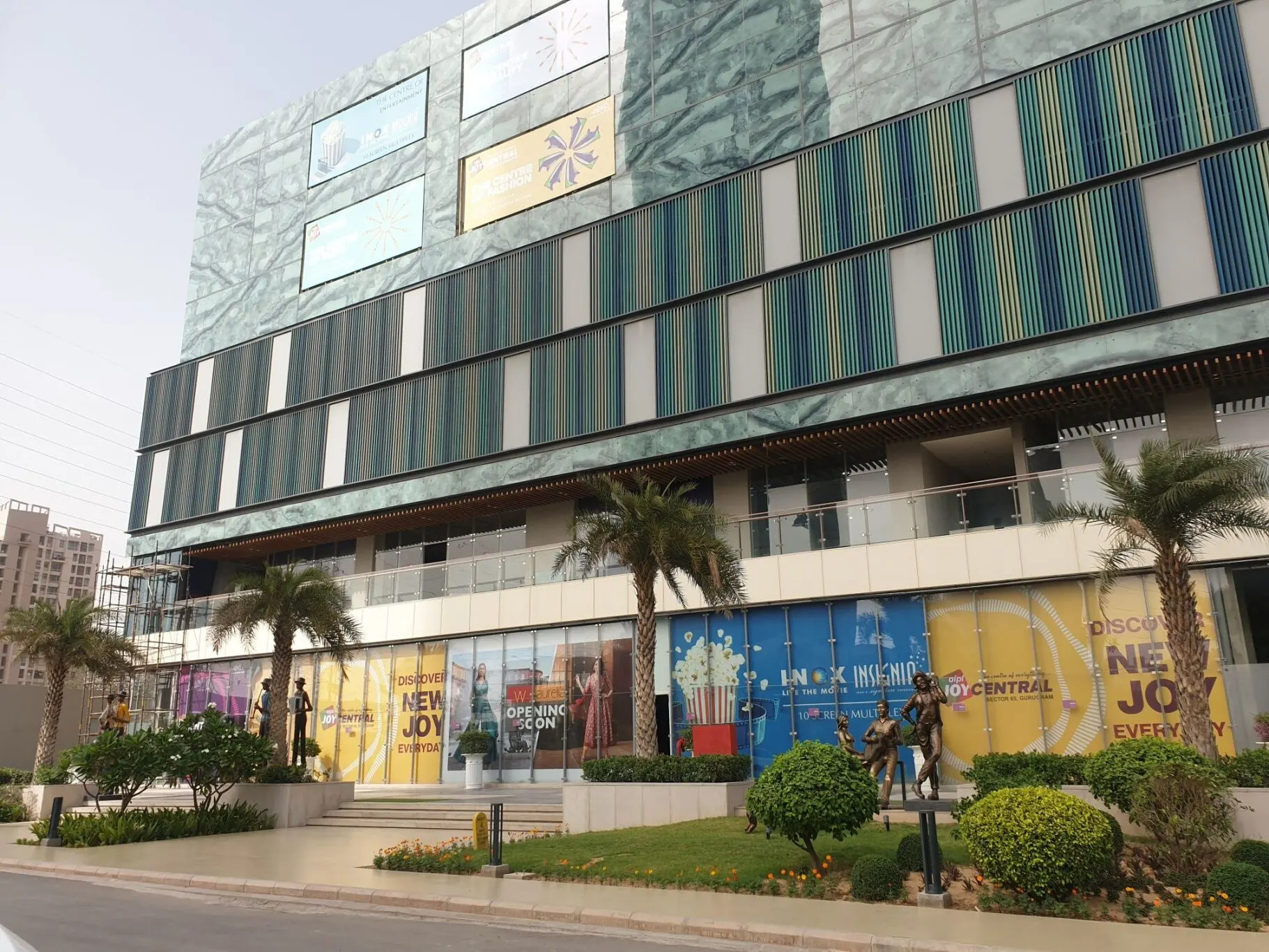
- AIPL Joy Central, Sector 65 on Golf Course Extension Road - offices and shops from 151 to 7,000 sq ft, ready to move.
- M3M Urbana, Sector 67 - 300 to 2,500 sq ft, completed December 2021, which means a building with an occupancy record you can check rather than a projection.
- Emaar Business District, Sector 114 on Dwarka Expressway - larger plot-format units, ready to move.
- M3M Paragon, Sector 57 - under construction, for occupiers who can wait and want first pick of the layout.
Small-format stock like this is where most sub-50-seat requirements actually land, because whole floors in Grade A towers start well above what a team that size needs. If you are weighing that against managed space, our coworking guide runs the break-even.