Something genuinely unusual happened to Gurugram's office market in 2026, and it is worth understanding whether you are a company looking for desks or an investor looking at commercial property.
In Q2 2026, Delhi-NCR recorded its highest ever quarterly flex office leasing. Flexible workspace operators accounted for about 45 percent of the 3.6 million sq ft of gross office leasing in the region — up from 0.3 million sq ft of flex leasing in Q2 2025 to 1.6 million sq ft. Nationally, coworking operators leased a record 8.6 million sq ft in the first half of 2026, roughly 32 percent higher year on year, with Delhi-NCR among the three cities accounting for about two-thirds of that.
In other words: for a large share of the market, the flex operator has replaced the conventional landlord. This piece covers both sides of that — what it costs you to be a member, and what it means if you own the space.
What a Gurgaon desk actually costs in 2026
Reported ranges, which vary by operator and move a great deal with location:
| Format | Reported monthly range | What it usually suits |
|---|---|---|
| Hot desk, standard operator | ~Rs 5,000 - 8,000 | Solo founders, consultants, part-time presence |
| Hot desk, premium operator | ~Rs 8,000 - 15,000 | Client-facing work where the address matters |
| Dedicated desk | ~Rs 10,000 - 20,000 | Teams of 2-10 with fixed staff |
| Private cabin / managed office | ~Rs 15,000 - 30,000 per person | Teams of 10-50 wanting their own door |
Location moves this more than format does. Private office quotes reportedly start nearer Rs 10,000 per seat on MG Road, sit around Rs 12,000-18,000 along NH-8, and can exceed Rs 25,000 on Golf Course Road. Same desk, same chair, different postcode.
The number to ask for is the all-in figure. Seat price frequently excludes some combination of meeting-room hours beyond a small credit, printing, dedicated internet, parking, after-hours air conditioning, and the setup fee. We have seen quoted-versus-actual gaps of 20 percent on the same contract. Ask for a sample invoice from an existing member rather than a proposal.
The break-even, done honestly

Here is the comparison most coworking articles avoid, because it does not flatter either side.
Take a conventional lease. Allocate 80 to 100 sq ft per person — that is a realistic Indian office density including meeting rooms and circulation. Your monthly cost per head is then:
- Rent per sq ft × 80-100
- plus common area maintenance
- plus fit-out, amortised — commonly Rs 2,000 to Rs 3,500 per sq ft as an upfront capital spend
- plus your own internet, housekeeping, pantry, security and facilities management
- plus a security deposit of typically six months' rent, which is dead capital
Run that with your actual quote. What you will generally find in Gurugram is that on rent alone, a conventional lease beats a managed seat — often comfortably. The reason companies still take flex is not that it is cheaper per rupee of rent. It is that:
- The fit-out is someone else's capital. A 30-person office at 2,500 sq ft and Rs 2,500 per sq ft of fit-out is roughly Rs 62 lakh you do not spend.
- The deposit is a fraction. Six months of a lease deposit versus one or two months on a flex agreement is a large working-capital difference for a growing company.
- You can shrink. A three-year lease means you pay for headcount you no longer have. This is the cost nobody models, and it is the one that actually bankrupts the comparison.
- Facilities are not your problem. No office manager, no AMC contracts, no arguing with the building about the lift.
So where is the crossover?
For most Gurugram companies it lands somewhere between 25 and 50 desks, but headcount is the least important of the three tests. Ask instead:
- Is your headcount stable enough to commit for three years? If your plan has a range in it rather than a number, stay flex.
- Can you fund the fit-out without it hurting? If that capital has a better use inside the business, stay flex — the return on your own product usually beats the return on your own carpet.
- Do you need brand control of the space? If clients or candidates walk through your office and the impression matters commercially, that is a real reason to lease, and it does not show up in a spreadsheet.
If any of the three is a no, stay in flex regardless of what the per-seat arithmetic says. If all three are a yes at 20 people, take the lease at 20 people. Our guide to office space for rent in Gurgaon covers the conventional side properly — micro-markets, rent structures and what to negotiate.
The other side: what the flex boom means if you own commercial space
This is where a lot of investors are drawing the wrong conclusion. "Flex operators took 45 percent of leasing" is being sold as a reason to buy any small office unit. It is not.
What flex operators actually need:
- Contiguous floor plates they can lay out — typically whole floors, not strata-sold cabins. A 300 sq ft unit is not addressable by an operator at any price.
- Building services that support high density. Desk density in a flex centre is far higher than a conventional office, which means lifts, power backup, air conditioning tonnage and washrooms all get stressed harder.
- Parking ratios that work at that density, which in most Gurugram buildings they do not.
- A location members will commute to. Operators are ruthless about this because their occupancy depends on it.
So if you are buying small strata units — the 150 to 1,000 sq ft stock that dominates Gurugram's commercial launches — your realistic tenant is a small business, a clinic, a professional practice or a service brand. That is a perfectly good tenant class. It is just not the one in the headline, and you should underwrite the rent accordingly rather than assuming operator demand will reach you.
Where the flex boom does help small-unit owners is indirectly: it is tightening Grade A availability, and tight Grade A eventually pushes price-sensitive occupiers down into exactly this stock. That is a second-order effect on a lag, not a direct bid.
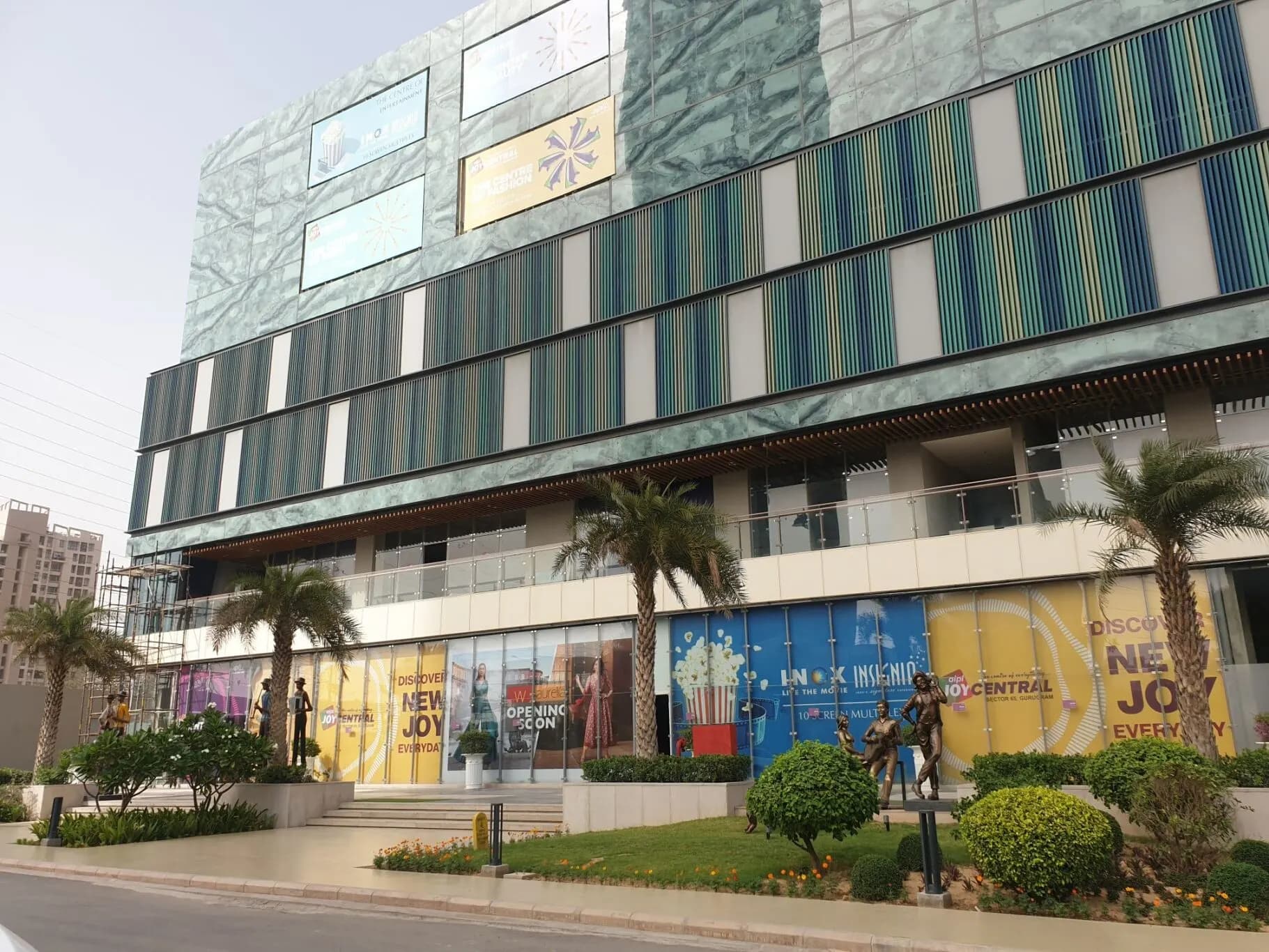
Live small-format commercial worth looking at on that basis includes AIPL Joy Central in Sector 65 (offices and shops from 151 sq ft, ready to move), M3M Urbana in Sector 67 (300-2,500 sq ft, completed 2021) and M3M Route 65. For the larger, plot-format end, Emaar Business District in Sector 114 and M3M SCO in Sector 113 are the ready options on Dwarka Expressway.
What to check before you sign — either side of the table
If you are taking seats
- Notice period, and what triggers it. The flexibility you are paying for lives entirely in this clause.
- Renewal escalation. A low first-year rate with an aggressive renewal is the oldest structure in this business.
- Exactly what the seat includes, and the overage rate on meeting rooms.
- Whether your seats are guaranteed or allocated. In a centre running at high occupancy these are very different rights.
- Who holds the electricity and internet contracts. If the operator has a dispute with the building, that becomes your outage.
If you are buying to lease
- The building's actual occupancy today, not its sold percentage. Sold and occupied are different numbers and only one of them produces rent for your neighbours.
- Power backup capacity per unit, in writing.
- The maintenance charge and who sets it, because it comes straight off your yield.
- Comparable rents actually achieved in the building, from a tenant if you can get one, not from the sales desk.
Our commercial property leasing guide goes through lease structures, escalations and lock-ins in detail, and retail shop rentals in Gurgaon covers the shop-format version of the same questions.
Our short version
For companies: flex is not cheaper, it is more flexible, and flexibility is worth paying for exactly as long as your headcount is uncertain. The moment it stops being uncertain, run the lease arithmetic properly — including the fit-out and the deposit — and be willing to switch.
For investors: the flex boom is real and it is mostly happening in floor plates you cannot buy. Small-unit commercial in Gurugram is still a decent asset class, but underwrite it on small-business rent, not on operator demand.
Either way, if you want a specific building or a specific quote checked, send it over. We look at both sides of these deals often enough to know where the numbers usually hide.