Every version of this comparison you have read runs the same way: a table of price per square foot, a paragraph about connectivity, a paragraph about lifestyle, and a conclusion that says it depends on your needs.
Here is a more useful starting point. Of the projects live on our books across Gurugram, exactly one sits in old Gurgaon proper — and it is a commercial project, not a home. Everything else new is somewhere else.
That is not an accident of our inventory. It is the structural fact about this market, and once you see it, the whole comparison reorganises itself. You are not choosing between two neighbourhoods. You are choosing between buying resale from an individual and buying primary from a developer — and those are different transactions with different risks, different paperwork and different room to negotiate.
Where the line actually falls
Old Gurgaon is the pre-2000s city: the low-numbered HUDA sectors including 4, 14 and 15, MG Road, the older DLF phases, Sushant Lok, and the belt around Rajiv Chowk and IFFCO Chowk.
New Gurgaon is the belt developed since roughly 2010 — largely Sectors 76 to 95 towards Pataudi Road and Manesar, with the Dwarka Expressway corridor and the Southern Peripheral Road sectors alongside it.
Neither boundary is official, and a listing agent will move them to suit whatever they are selling. If a "New Gurgaon" flat has a Sector 45 address, someone is being creative.
The supply asymmetry, in one number
In old Gurgaon there is no land left. The area was built out decades ago and the only route to new supply is redevelopment — slow, legally awkward and rarely economic at scale.
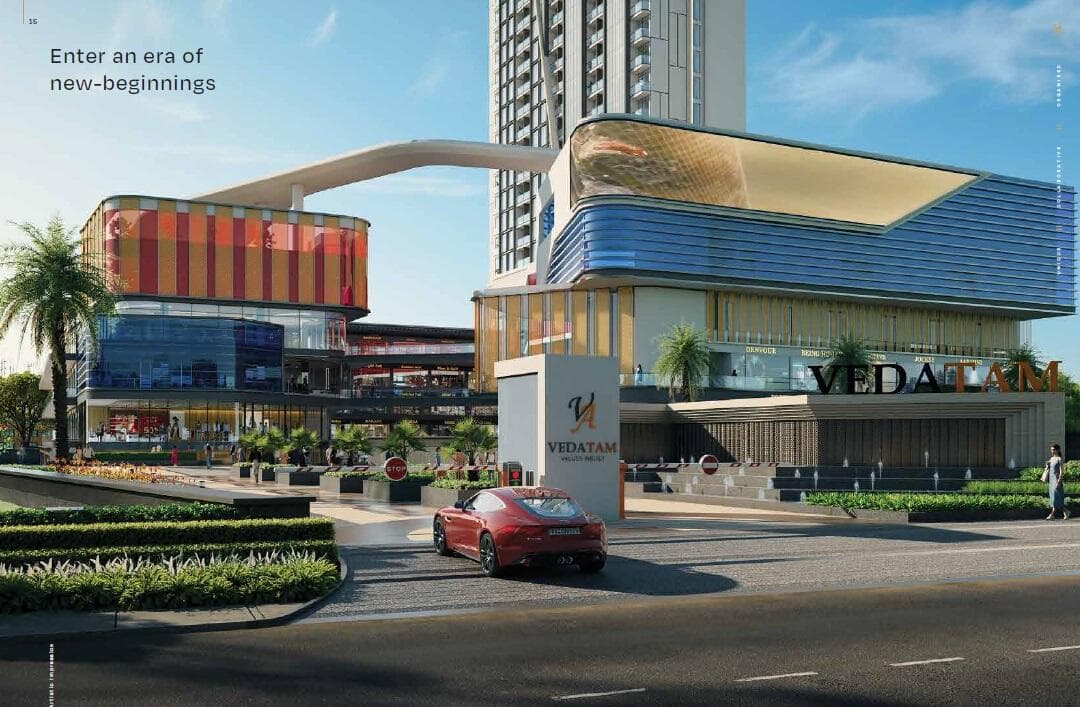
The one live project we have in old Gurgaon is SPJ Vedatam in Sector 14: commercial shops of 300 to 2,500 sq ft from about Rs 50 lakh, by SPJ Group, currently under construction. A commercial project, in a residential heartland, because retail is what still gets built where there is no room for towers.

Now the other side. In the New Gurugram and adjacent belts you can currently choose between projects in Sectors 76, 77, 78, 79, 79B, 80, 83, 85, 86, 89, 90 and 93 — from Signature Global City at around Rs 1.62 crore to DLF Privana North at Rs 9.15 crore and up.
That asymmetry has three consequences that no price table will show you.
1. Negotiation works differently
Against a developer with unsold inventory you negotiate on payment plan, floor rise, parking, club charges and possession-linked terms. Against an individual owner in old Gurgaon you negotiate on price alone, and their willingness depends on their own capital gains position and what they are buying next. Our guide to capital gains tax on property sale in Gurgaon explains why a seller may refuse a lower price that costs them more in tax than it saves you.
2. The diligence is a different checklist
A primary purchase turns on RERA registration, the builder-buyer agreement, the delay-compensation clause and the payment plan. A resale purchase turns on the chain of title, the society's no-dues certificate, whether property tax is paid up to date, the physical condition of the structure, and the age of the lifts and services. Applying the first list to the second is the most common mistake old-Gurgaon buyers make. The full list is in documents required to buy property in Gurgaon.
3. GST lands on only one of them
A resale flat and a completed unit sold after the occupation certificate are outside GST entirely — the sale of a completed building is treated as immovable property rather than a service. An under-construction purchase is a supply of construction services and is taxed accordingly. On a Rs 3 crore home that difference is not a footnote, and it quietly narrows the gap between an old-Gurgaon resale and a New Gurgaon launch.
What the rates actually say
This is where most comparisons go wrong, because old Gurgaon does not have one rate — it has several, depending on whether you are pricing an ageing apartment, a builder floor or an independent house on a large plot.
Reported figures put Sector 14 apartments near Rs 12,950 per sq ft, while the sector's blended average — which sweeps in independent houses on generous plots — is quoted far higher. In New Gurugram, 99acres data for Sector 89 puts flats at roughly Rs 9,800 to Rs 13,200 per sq ft, with builder floors around Rs 11,050 to Rs 13,400.
Read those two ranges next to each other and the popular story — that old Gurgaon is dramatically more expensive — largely dissolves for comparable apartment stock. The gap that does exist buys you location, not building.
And that is the trade in one sentence: in old Gurgaon you pay for where the property is and accept what it is; in New Gurgaon you pay for what the property is and accept where it is.
The metro that is actually being built
The strongest argument for New Gurgaon over the next few years is not a new sector. It is a rail line.
A 28.5 km corridor with 27 stations is under construction between Millennium City Centre and Cyber City, approved at roughly Rs 10,266 crore, covering Hero Honda Chowk, Subhash Chowk, Sector 10 and Palam Vihar, with a spur towards the Dwarka Expressway. Civil work — piling and pillar casting — is under way on the 15.2 km stretch from Millennium City Centre to Sector 101. Trial runs on the first phase are tentatively planned for early 2027, with completion targeted around mid-2027.
Two things make this different from the usual metro claim in a Gurgaon sales pitch:
- It is under construction, not at report stage. Compare that with the proposed Sector 56 to Pachgaon corridor, which has a cleared detailed project report but no state or central approval yet.
- It connects the two halves of this comparison. Millennium City Centre is old Gurgaon's interchange with the Delhi Metro Yellow Line; Cyber City is where the jobs are. The line's whole purpose is to close the gap that this article is about.
If it lands on schedule, some of what you currently pay old Gurgaon for — proximity — becomes purchasable from further out. Whether that shows up as New Gurgaon rising or old Gurgaon flattening is the open question.
The third option nobody lists
There is a belt that belongs to neither category: the older, greener eastern edge along Gurgaon-Faridabad Road.
Adani Lushlands at Gwal Pahari is 4 and 6 BHK homes of 3,315 to 6,495 sq ft at Rs 8.14 to 21.74 crore — roughly Rs 24,600 per sq ft at entry. It is neither the dense old city nor the new-sector grid: low density, Aravalli-side, and closer to south Delhi than most of Gurgaon is.

It is a small market with thin comparables, which cuts both ways: little competition when you buy, and little liquidity when you sell.
Which one is for you
| If you... | Look at | Because |
|---|---|---|
| Need to move in now and work on MG Road or in Cyber City | Old Gurgaon resale | The location works today; you are buying proximity, not a building |
| Want a new build with a warranty and working services | New Gurgaon primary | Old Gurgaon has almost no new supply to sell you |
| Have Rs 1.5 to 2.5 crore | New Gurgaon | Entry tickets in Sectors 79B, 89 and 90 start there |
| Want land or a low-rise floor | New Gurgaon or the SPR sectors | Plotted and floor supply is where the land is |
| Are buying to let | Old Gurgaon, carefully | Deeper tenant demand near the offices - but check the building's age |
| Are buying for 2032 and beyond | New Gurgaon | You are buying the metro and the sector's build-out, not today's state |
The honest summary
Old Gurgaon is a resale market wearing a location premium. New Gurgaon is a primary market wearing a discount for everything that has not been built yet. Per square foot, comparable apartment stock is far closer than the reputations suggest.
Pick by transaction type first — resale or primary — because that decides your paperwork, your negotiation and your tax position. Pick the sector second. Doing it the other way round is how people end up with the right postcode and the wrong purchase.
Related reading: New Gurgaon vs Dwarka Expressway, top growing property areas in Gurgaon, and how to sell property in Gurgaon if you are on the other side of an old-Gurgaon resale. Current listings sit under projects in Old Gurgaon and projects in New Gurgaon.